
When transitioning to SAP S/4HANA, organizations typically choose one of three implementation approaches: Greenfield, Brownfield, or Selective Data Transition. In this blog, we’ll take a closer look at the Selective Data Transition—what it is, how it works, and the advantages and challenges that come with it.
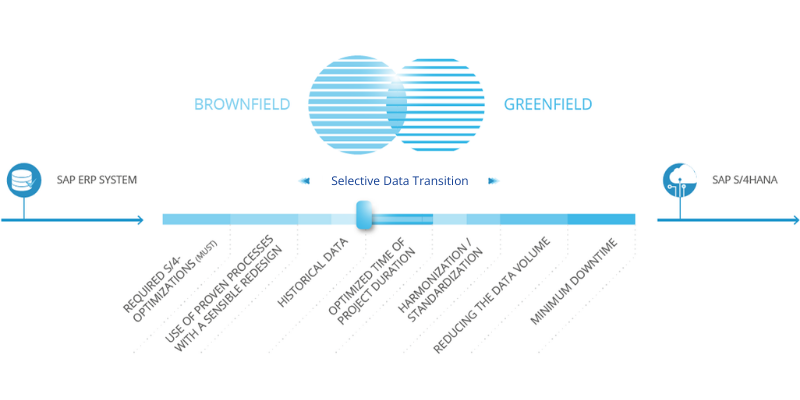
Selective Data Transition
The third and final conversion method is an SAP S/4HANA Selective Data Transition (SDT). It is often called a landscape transformation or hybrid approach which gives organizations the flexibility to consolidate multiple ERP systems or company codes into a single SAP S/4HANA environment. Instead of migrating all historical data, SDT allows you to selectively move only the datasets most relevant to your business, significantly reducing time, effort, and complexity.
Both selective migration of historic data (time slicing), staggered transitions (template), and data harmonization are possible. System merges and carveouts are supported as well, giving organizations a high degree of control over scope and sequencing. SAP S/4HANA On‑Premise and Public Cloud are both suitable for this approach, offering deployment flexibility based on your strategic and operational needs.
SDT also enables you to schedule migrations around fixed dates and predefined timelines, minimizing operational disruption. By combining selective process redesign with targeted data transformation, SAP S/4HANA SDT delivers a strategic, efficient path to S/4HANA—one that accelerates transformation while maintaining flexibility and governance.
Finding the right transformation partner
Once you’ve identified the right transformation path, the next step is choosing an implementation partner. If you decide to work with ORBIS, we’ll develop a tailored roadmap to ensure a secure and efficient data migration. The journey to S/4HANA can be complex, but we help you navigate each step with confidence and clarity.
One of the most significant challenges in any transformation is the migration of your data. This process is inherently complex and highly dependent on your organization’s unique system landscape. Whether you’re pursuing a new implementation, conversion, or upgrade, we begin with a comprehensive four‑step evaluation of your operational processes. This ensures we can plan and execute your integration with maximum efficiency and identify the path that truly fits your business.
Step 1: As-Is Analysis
This analysis involves evaluating your existing IT architecture to understand which business processes, data, and systems need to be included in the S/4HANA implementation.
Step 2: SAP Readiness Check
During the readiness check, we look at potential problems and challenges that we need to resolve before migrating your data (custom code check included).
Step 3: Development of Operating Concept
We create a detailed operating concept that describes the planning, implementation, and monitoring of your S/4HANA transition. This ensures that you have the necessary technical and specialist resources and experts on hand.
Step 4: SAP S/4HANA Transformation
Our final roadmap allows us to carry out the changeover securely and according to plan.
With SAP S/4HANA at the core of our expertise, we help mid‑size industrial companies unlock the full potential of their business processes—quickly, safely, and with industry‑proven precision. As a certified SAP Partner with more than 35 years of experience across every phase of transformation, we bring both the technical depth and industry insight needed to deliver real results. And with our modular transformation toolbox, developed alongside trusted partners, we tailor every S/4HANA journey to your exact needs. When you’re ready to move forward with confidence, we’re the partner that knows how to get you there.